
2010 Wind-up Slideshow: Berenice’s trip from Malta to 27 cities including Tuscany, London, Paris, Düsseldorf, Loire Valley, Verona, Dijon, Lausanne, La Rochelle, Barossa Valley, Goulburn, Adelaide Hills, Nuits-Saint-Georges, Mornington, McLaren Vale, Coonawarra, Jura (near Arbois, Franche-Comté, France), Yarra Valley (near Ringwood, Victoria, Australia), Chassagne-Montrachet (near Puligny-Montrachet, Burgundy) and Aÿ (near Dizy, Champagne-Ardenne) was created by TripAdvisor. See another Italy slideshow. Create a free slideshow with music from your travel photos.
Friday, December 31, 2010
2010 Wind UP
A successful year indeed! A few photos to narrate my last year. These inspire me to look with anticipation to the new adventures which 2011 will bring. Wishing everyone a great year and thanking all those who were part of my 2010!


Saturday, November 13, 2010
Yarra Valley Regional Overview by Phil Sexton
The great and important task of giving us a regional overview of the Yarra Valley was given to Phil Sexton. Co-founder of Australia's first microbrewery, Matilda Bay Brewery back in 1984, Phil moved to the Yarra to produce wine with a sense of place. In fact all of his wines under the Giant Steps label come from a single vineyard. Phil also created the Innocent Bystander label which has a trendier image with wines like Moscato, Pinot Gris and Viognier; aromatically making their way to the younger wine drinker.
Phil built an image and name of his own in the little town of Healesville in the heart of the Yarra Valley. Anyone can enjoy a lovely brekkie or meal at his bistro and of course taste his range of wines. Listening to Phil talk was an experience of its own for me since this man has passion for wine, marketing vision and business acumen all rolled up in his sleeve.
Friday, November 12, 2010
A New Wave of Wine Thinkers!
Around 2 months ago, just as I landed in Coonawarra, I came across an article by Huon Hooke (http://www.smh.com.au/executive-style/top-drop/who-dares-wynns-20100810-11ukr.html), where he stated how dormant the region of Coonawarra is and how it lacks innovation when compared to other wine regions in Australia. Being only at the start of my Australian wine experience I immediately critised this article and held a grudge against this wine writer thinking that if a wine region excels at producing a particular style of wine it should stick to that style and improve on it.

Yet once again I was wrong. Not in the fact that Coonawarra produces a great expression of Cabernet Sauvignon but I hadn’t yet experienced the wine regions of Yarra, McLaren Vale and the Barossa to make an unbiased judgement. Focusing for 2 days on the Yarra Valley during the James Busby tour made me realise how wine producers like Mac Forbes, Timo Mayers, Luke Lambert, Phil Saxton at Giant Steps and Stephen Webber at De Bortoli are becoming the point of reference in their region. Bringing a different and fresh approach to wine making which some might interpret as a weird nut case yet is surely appreciated by most.

What makes these producers stand out of the crowd is their wine making philosophy. Whole bunch fermentation, no or low % of new oak, only French oak used, site selection, total vineyard management, no fining and filtration, wild yeast; where all common statements made by these producers. But what is the reasoning behind such wine making practices?
Whole bunch fermentation is an “old” practise used mainly in Burgundy for the fermentation of Pinot Noir and Gamay. This reduces the amount of handling of the grapes thereby retaining great fruit flavours without imparting any harsh tannins which can imbalance wines made from Pinot Noir. This balance and freshness of fruit was easily identifiable in the Riorret The Abbey 2008 Pinot Noir by de Bortoli; light in colour with perfumed aromas of strawberries and rhubarb, delicate soft tannins with cherry flavoured mid-palate. The same freshness can be felt when tasting the Mayer Pinot Noir 2008 by the German Aussie Timo Mayer. This wine is 40% whole bunch fermented therefore tannins where slightly more grippy with savoury characteristics also showing on both nose and palate. Intense long finish ideal for the steak sanga served for lunch at Timo’s.

The careful use of oak was also a subject touched upon during various visits on our tour. American oak is seen as a curse whilst new French oak is now avoided for most wines in the Yarra. Steve Webber explained how at De Bortoli new oak is used for their lower end wines so that the oak tannin and flavour are not imprinted on their higher end wines were fruit expression is paramount. The Yarra Valley Estate Grown Chardonnay 2008 is a very enjoyable light weight Chardonnay with less oak characteristics “usually” found in Aussie Chards and more of the citrus flinty nuances coming through.


Yet once again I was wrong. Not in the fact that Coonawarra produces a great expression of Cabernet Sauvignon but I hadn’t yet experienced the wine regions of Yarra, McLaren Vale and the Barossa to make an unbiased judgement. Focusing for 2 days on the Yarra Valley during the James Busby tour made me realise how wine producers like Mac Forbes, Timo Mayers, Luke Lambert, Phil Saxton at Giant Steps and Stephen Webber at De Bortoli are becoming the point of reference in their region. Bringing a different and fresh approach to wine making which some might interpret as a weird nut case yet is surely appreciated by most.
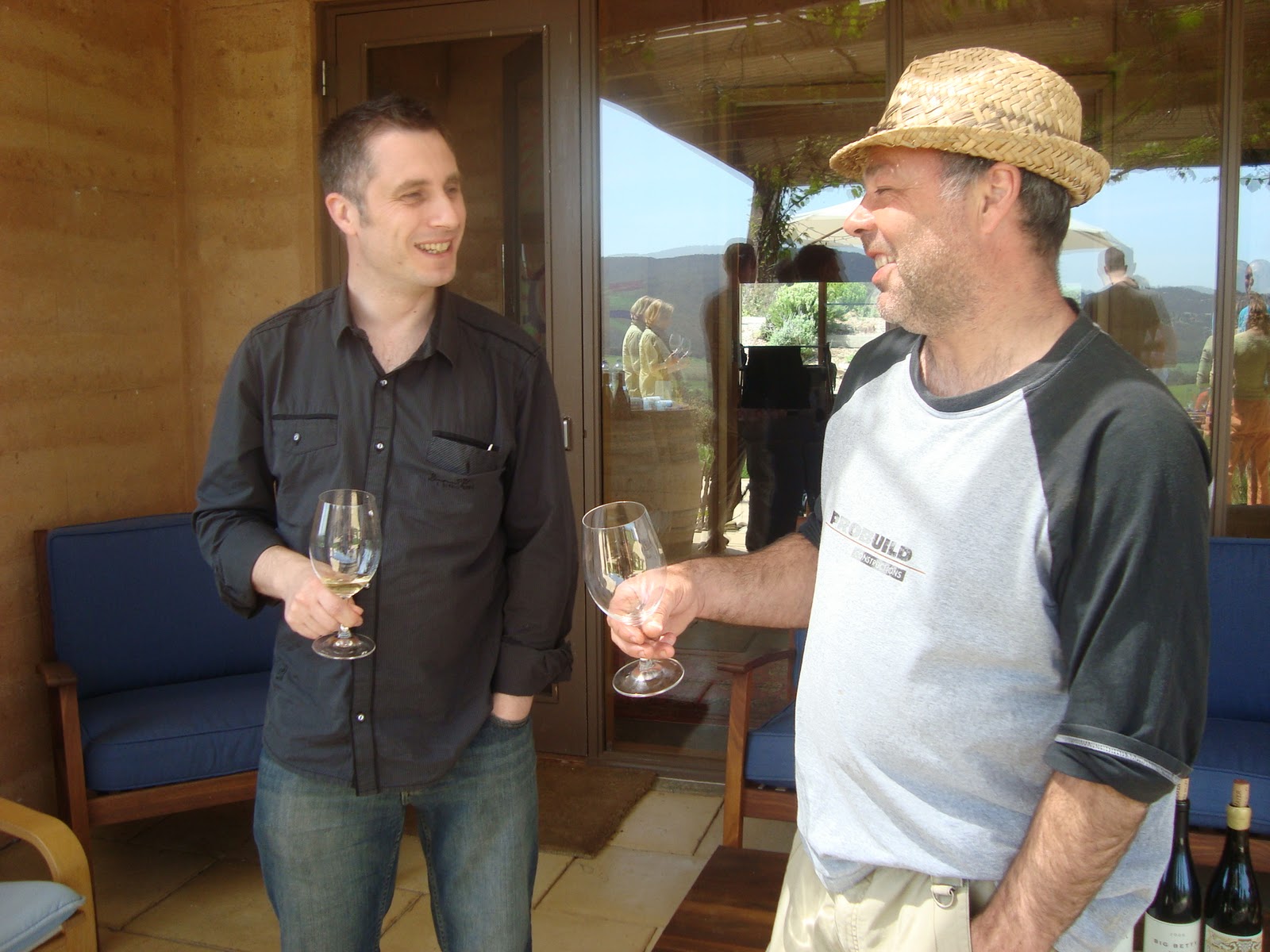
Whole bunch fermentation is an “old” practise used mainly in Burgundy for the fermentation of Pinot Noir and Gamay. This reduces the amount of handling of the grapes thereby retaining great fruit flavours without imparting any harsh tannins which can imbalance wines made from Pinot Noir. This balance and freshness of fruit was easily identifiable in the Riorret The Abbey 2008 Pinot Noir by de Bortoli; light in colour with perfumed aromas of strawberries and rhubarb, delicate soft tannins with cherry flavoured mid-palate. The same freshness can be felt when tasting the Mayer Pinot Noir 2008 by the German Aussie Timo Mayer. This wine is 40% whole bunch fermented therefore tannins where slightly more grippy with savoury characteristics also showing on both nose and palate. Intense long finish ideal for the steak sanga served for lunch at Timo’s.

The careful use of oak was also a subject touched upon during various visits on our tour. American oak is seen as a curse whilst new French oak is now avoided for most wines in the Yarra. Steve Webber explained how at De Bortoli new oak is used for their lower end wines so that the oak tannin and flavour are not imprinted on their higher end wines were fruit expression is paramount. The Yarra Valley Estate Grown Chardonnay 2008 is a very enjoyable light weight Chardonnay with less oak characteristics “usually” found in Aussie Chards and more of the citrus flinty nuances coming through.

Apart from the diversified wine making practices, these wine makers chose to play around with different grape varities as well. Very interesting to taste was the RS 37 by Mac Forbes. A Riesling from the Strathbogie ranges with 37 grams residual sugar derived mainly by stopping fermentation with a drop in temperature of the wine to 1 degree then adding sulphur dioxide to stabilize the wine. The result is a very aromatic wine with lovely floral aromas. A good palate with acidity at 9grams/litre balancing out the sugar; lovely texture with no cloying feeling at the finish. Another interesting wine from Mac Forbes was the Hugh Bordeaux blend of Cabernet Sauvignon, Merlot, Cabernet Franc and Petit Verdot. Again coming from strict site selection which Mac always supervises with great care, the fruit comes for the sub region of Gruyere in the Yarra. All varieties are fermented and matured separately using open vat fermentors which Mac explained as being vital for the tannins to integrate better; oxygen is needed both during fermentation and oak maturation for tannins to marry. Still a bit withdrawn on nose and palate this wine needs time to open up. Black berries, plums and hints of herbs on the nose. Great broad structure with chewy dusty tannins balancing the great fruit on the mid-palate.

Standing in the shadow of the more lively winemakers in the Yarra is Luke Lambert yet his wines are louder than a rock concert. Producing the king of wines and wines for kings (Barolo), Nebbiolo is a grape variety I am very much familiar with yet which I least expected to be tasting in Australia. Luke produces two Nebbiolos, one coming from the warm region of Heathcote and another coming from the cooler region of Yarra. Again these wines were a bit shy for starters but opened up nicely after some time in the glass. Typical perfumed nose with herbal aromas, “le spezie” which I find so prominent in the Italian Nebbiolo versions. Plump red fruit mid-palate with typical high acidity and dusty tannins. Great pureness of fruit in this wine which was also a feature I found in Luke’s Syrah. Delicate and supple with bright red fruit and a spicy smooth finish.

Different approaches to wine create different styles and a great variety to choose from. Like a 5 year old in a lolly shop its hard to pick my favourite wine out of the ones we tasted; maybe I can still convince my mummy to buy the lot! :)
Tuesday, November 2, 2010
Dating back to the 1860s
Our first introduction to the Tahbilk winery was a boat tour on the Wetlands which make part of the Tahbilk Wetlands & Wildlife Reserve. The Nagambie Lakes Region in Upper Goulburn is the only wine region in Australia where the meso-climate is influenced by inland water masses. The lakes keep the climate cooler thereby the ripening of the grapes is slower, retaining the aromatics in the grapes which are very much sought for in varieties like Marsanne.

The visit hosted by Alister Purbrick himself was a fruitful one giving insights on how tradition, history and family are common features that have shaped Australian wineries.
Being such an important variety for the Tahbilk winery Masanne was the first variety featuring in our tasting. Whilst the 2008 and 2009 both featured floral notes, the 2001 vintage produced from the 1927 vines had more complex and richer notes on the nose with ripe apricots, caramelised nuts and orange peel. The palate had a lovely lean acidity balanced off with great minerality.
The line up of Shiraz and Cabernet wines was just startling. The 1996 Shiraz from the ‘1860 Vines’ was one of my favourite; plum intermingling with earthy and savoury notes on the nose, silky tannins with lovely mid-palate fruit, intense but not concentrated. The Reserve Shiraz, 1999 was also surprisingly lifted and fresh; strawberry hints with Mon Chéri chocolate notes, velvety tannins and a long spiced finish. The Eric Stevens Purbrick Cabernet Sauvignon 2005 shows how elegance and harmony are found even at an early age. Ruby red in colour with a black fruit profile of blackcurrants and blackberries, tannins very present yet balanced with a long liquorish mocha finish.
 Even if the Australian wine industry is young, drinking the 1996 Shiraz from ‘1860 vines’ made me realise how unique Australian old vines are and how lucky I am to be on this part of the world. A really great tasting and winery visit which brought forward the importance of heritage for Australian wineries.

The visit hosted by Alister Purbrick himself was a fruitful one giving insights on how tradition, history and family are common features that have shaped Australian wineries.
Being such an important variety for the Tahbilk winery Masanne was the first variety featuring in our tasting. Whilst the 2008 and 2009 both featured floral notes, the 2001 vintage produced from the 1927 vines had more complex and richer notes on the nose with ripe apricots, caramelised nuts and orange peel. The palate had a lovely lean acidity balanced off with great minerality.
The line up of Shiraz and Cabernet wines was just startling. The 1996 Shiraz from the ‘1860 Vines’ was one of my favourite; plum intermingling with earthy and savoury notes on the nose, silky tannins with lovely mid-palate fruit, intense but not concentrated. The Reserve Shiraz, 1999 was also surprisingly lifted and fresh; strawberry hints with Mon Chéri chocolate notes, velvety tannins and a long spiced finish. The Eric Stevens Purbrick Cabernet Sauvignon 2005 shows how elegance and harmony are found even at an early age. Ruby red in colour with a black fruit profile of blackcurrants and blackberries, tannins very present yet balanced with a long liquorish mocha finish.

Tuesday, October 19, 2010
Focusing on Mornington Peninsula
On to the bus again for the second day of the James Busby tour. The Mornington Peninsula was our next focus and the first host of the day was winemaker Sandro Mosele from Kooyong (where the wild ducks gather) winery, owners of Port Philip Estate. With over 1000 hectares of vineyards and around 60 cellar doors the Mornington Peninsula is one of the most well known regions in Australia for producing Pinot Noir. Surrounded by Port Philip Bay, Westernport Bay and Bass Strait, the Morning Peninsula has a unique maritime climate with different soils structures attributing to the different styles of wines produced.

The region is sub-divided into two regions; Up the hill and Down the hill. As the name suggests, Up the hill has cooler site climate due to elevation producing rounder wines with more minerality and savoury characteristics whilst Down the hill produces wines of a more robust, elegant and assertive structure. Sandro Mosele gave us a clear outlook of the region and then proceeded with a very interesting tour of the vineyards and the winery. The vineyards were planted after rigorous testing and mapping of the soil in order to save time and money experimenting with different vineyards for different sites. Sandro also explained the increasing effort to reduce berry size to around 0.7grms other than the average size of 1.2grms to add tannin and structure to his wines. The wine is given as much freedom as possible during fermentation with open vat fermentation, natural yeasts and no pumping over used. Cold extraction of around 7 to 8 days led up to a slow alcoholic fermentation. Around 18 months of barrel ageing for the reds always using the revered French oak. Remarkably both William Downie who we visited on day 1 and Sandro look down on American oak and quoting Sandro “it is only good for furniture” gives a clear cut statement on his view about American oak.

After visiting their new bottling line which was the latest investment together with the cellar door and restaurant we started our first tasting of the day. The tasting was held in their bistro which overlooks the stunning Kooyong vineyards. Starting off with a Pinot Gris 2009 which was more of Pinot Grigio in style with floral and almond notes on the nose; nice refreshing acidity on the palate. The Chardonnays followed; Port Philip Estate 2008 which had a very citrus character, broad yet elegant; the Farrago 2008 which had more apple and pear nose, fuller on palate with a lasting minerality; the Faultline 2008 which like the Farrago is a single vineyard wine featuring mostly stoned fruit and hints of butter on the nose, delicate and subtle and the lastly Kooyong Estate showing interesting expressions of butteriness and nuts on both nose and palate.

The reds all coming from Pinot Noir yet again showing different styles according to vineyard location and winemaking techniques used. The Meres 2008 was light, sappy and full of fragrance; the Haven 2008 had maraschino cherries on the nose with good depth on palate; the Haven 2009 had more lifted aromas with more structure and density on the palate; the Ferrous 2005 had complex earthy notes with good vibrant fruit still present on both nose and palate; the Kooyong Estate 2000 was my favourite introducing more liquorish fruit on nose, ageing gracefully.

After such an interesting overview of the region and an insight about the various styles of wines produced from the different sites we headed off to a smaller winery Ocean Eight. Unexpectedly we were greeted by oysters and sparkling wine; a Champagne sensation that all made us smile. For me this visit was exceptionally interesting since Mike Aylward took us through some barrel samples of the different Pinot Noir clonal selection he uses for his Pinot Noir. Immediately I felt challenged by the tasting since I am rather unfamiliar with both barrel samples and mostly barrel sampling of different clonal selection. Mike uses 3 clonal selections all contributing different aspects to Pinot Noir. Clone 115 had a very interesting perfumed violet nose with good structure on the palate. Clone MV6 (a Clos Vouguet pre- phylloxera clone) cropped at 1 tonnes per hectare had more structure and richness on the palate whilst clone 114 had more subtle red fruit texture coming through. These 2 clones give the right balance and depth in texture for the Aylward Pinot Noir Mike is seeking to produce. Tasting the Aylward 2007 you can then notice how all these characteristics come together as the jigsaw puzzle becomes more complete.

Like an artist a winemaker has different colours with which to paint his canvas; clones, soil texture, rootstock, French and American oak, screw caps and corks, sulphur, acidity levels and ph levels. Which to choose and how to make use of these tools is completely up to the winemaker as long as the final result reflects the grape variety and the distinct style of the region.
Monday, October 18, 2010
On the rolling hills of Gippsland
A great start to a weekend tasting wines during the Cabernet weekend in Coonawarra (of which I will write at a later stage), led off to my much anticipated 2 week James Busby tour. So, as soon as all the people were gathering in Penola for the Cabernet Celebrations and the canonisation of Mary MacKillop I was on my way out to start another 2 week wine adventure.
Meeting the group at the hotel in Melbourne brought together a simple definition of the profile of people living in UK; multi-cultural energy. It was slightly difficult to get my ears fine tuned to all the different accents and different name pronunciations. Yet as always in the wine industry brings together interesting people with different backgrounds and all on a different journey with the same purpose, discovering wine.

With a pretty full itinerary we hit the road early Monday morning to Gippsland. After a couple of hours drive we were all looking forward to taste some nice wines and enjoy our first Aussie bbq. As we stepped down from the bus we were greeted by the young winemaker William Downie and his wife Rachel. As soon as he started talking about his experience whilst working in Burgundy and the careful selection he goes through to buy his fruit I immediately knew that his Pinot Noirs will be remarkable. The first wine on tasting was Stool on a Stool (No Sulphur) Pinot Noir. Sulphur is quite a hot topic amongst winemakers and according to William added sulphur reduces the expression of the wine by 20%. So what to expect from a wine with no sulphur added and no filtration? Well, a very vibrant purple coloured wine filling the glass with lovely cherry and violet notes; sappy and lively on palate. A great way to start our lingering bbq lunch.

As starter we had a lovely seafood salad which matched perfectly the 2009 Petit Manseng from the King Valley. My experience with this grape variety is very limited. Floral notes with hints of pears and pineapples on the nose whilst the palate had a very broad texture with acidity giving it the right lift and a good long finish. With 50grms residual sugar you would expect a cloying heavy wine yet this had a refreshing acidity which gave it perfect balance and great definition.

The succulent bbq lamb was paired with 3 different Pinot Noirs (2008 vintage) showing the stylistic difference between the different areas of production William sourced his fruit from. The Yarra Valley brought forward the lively cherry aromas with slight developing earthy notes; medium light on palate. The Mornington Peninsula had the same red fruit profile yet with denser texture and more structure on palate. The Gippsland had a darker fruit aroma spectrum with a full palate and velvety tannins. All very interesting and all bringing forward different aspects of such an interesting grape variety. To wrap up the lunch we were delightfully served a selection of different cheeses and yes some more wine, 2004 and 2005 Pinot Noirs from Yarra Valley in magnum format. The 2004 had some garnet hues on the rim and developing aromas of mushrooms and earthiness yet with subtle cherry notes; all intermingling on the palate with its velvet tannins. The 2005 had a more structured palate with present tannins and lovely fruit on the mid-palate; interesting to taste within a couple of years.

I cannot but end up with a quote from the man of the day, William Downie “What I am trying to produce is an expression of Pinot Noir which can give a unique profile not a Burgundian one.” Whilst most producers are always on the constant search of replicating a French or an Italian style of wine this Aussie winemaker is producing a unique wine; many should follow.
Friday, October 1, 2010
Frenchie Bubbles in Robe
After visiting Champagne and tasting some great wines at the Vins et Terres de Champagne, the least I expected is to end up at a great Champagne tasting in Australia. Yet I am a lucky girl and thanks to Peta, an ex-sparkling wine maker at Hardy’s I was in for a treat. The brand Champagne portrays finesse, elegance and high quality; this was exactly the result of the tasting I had the pleasure to attend last weekend.


I am not going to bore you with the same details on grape varieties, soils and methods of production; all that is found in books and of course is important to know before such a tasting. Yet what struck me most at this tasting was the variety of styles that can be very distinctive according to the house or brand behind the label. The tasting was split in 2 flights of 5 wines and from the first 5 I picked one of the least favourite by the other winos; Lanson Gold Label 1996. Composed of 57% Pinot Noir and 43% Chardonnay, this wine had a multi-layered nose with citrus and lemon rind as primary aromas and the brioche, toast and honey coming through more pronounced. The palate had more citrus fruit and a mouth puckering acidity which cuts right through the mid-palate; a long persistent mineral finish. I was one of the few who picked this wine as their favourite and the debate was most about the nose; has this wine got too much of a sherry aroma to it? Is it complex or is this wine lacking freshness? As for me, I could just sniff this wine for hours without getting tired and the fact that the palate had such refreshing mouth watering acidity (coming from the lack of malo-lactic fermentation whilst wine making) made the unexpected contrast more interesting for me. Of course the class and poise of the Dom Perignon 2000 couldn’t be unappreciated or undervalued. The lovely white flower intermingling butterscotch and hazelnut aromas; then the creamy fine bubbles and the long complex finish made this wine stand out from the bubbly crowd. :)

The next flight of wines were really tough to pull apart and choose your favourite; tough job yeah! :) Pressed to choose, I picked the Krug Grande Cuvee Multi-Vintage; MV actually meaning NV yet sounds classier, typical Champagne branding! :) Again this wine had a wide spectrum of intense aromas yet what I enjoyed most was the palate which had a lively acidic attack balanced out with citrus and savoury notes; sweet and sour as someone around the table described it. The 1998 Sir Winston Churchill by Pol Roger was also enjoyed by many. This Champagne had more of a female touch to it; more finesse than robustness. The nose had a particular floral lift which gave the wine more youthfulness and its racing acidity with ripe apple smoothness on the palate showed this wine will develop further in years to come.

Champagne, the same ingredients with a multitude of recipes, gives diverse styles which can please extensively on both nose and palate. Hopefully this tasting helped Peta get closer to her Champagne dream and win the Champagne trip in October organised by CIVC. For me it was another discovery and learning experience.. Bring them on! :)
Subscribe to:
Posts (Atom)


